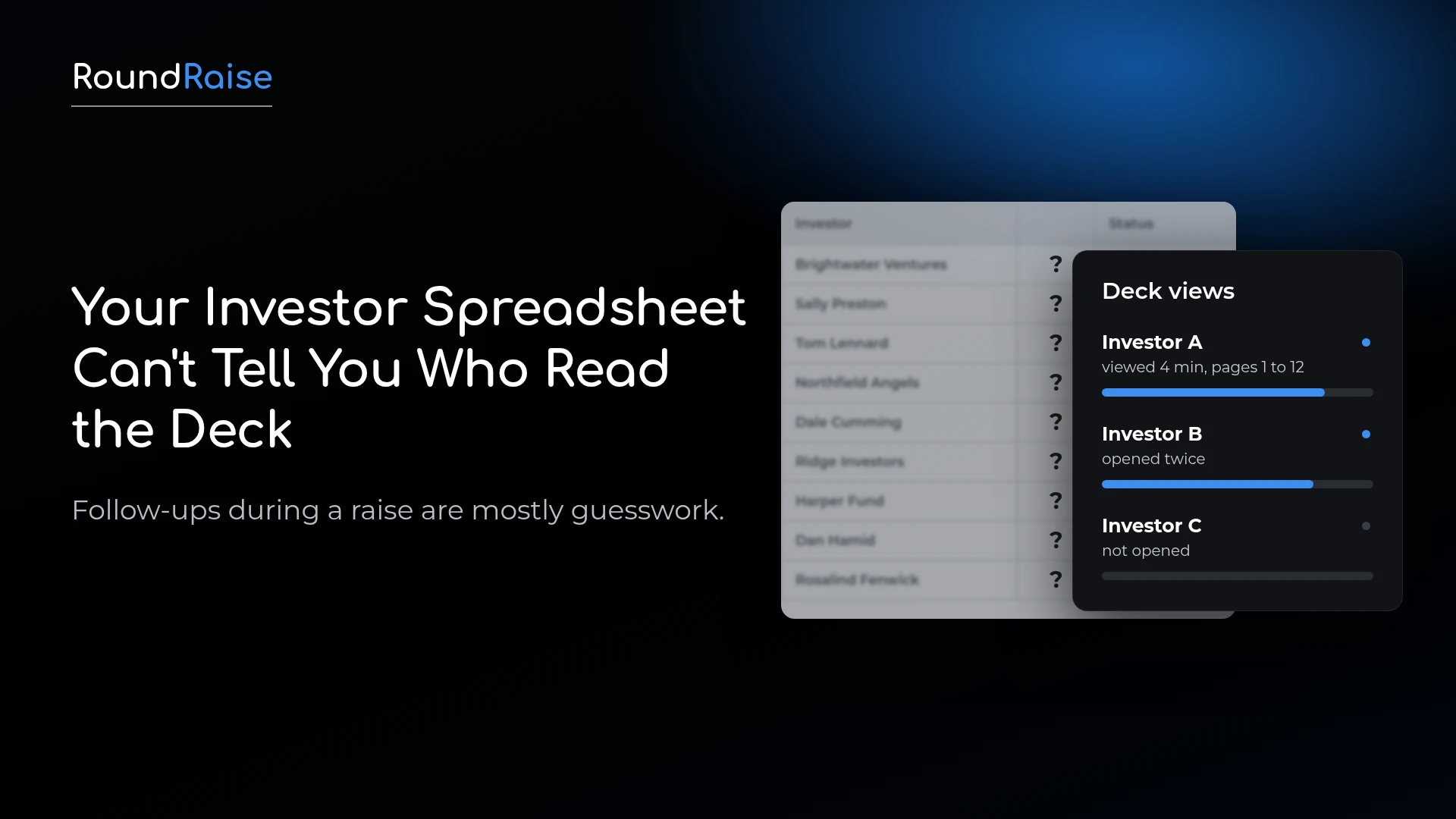
Your Investor Spreadsheet Can't Tell You Who Read the Deck
3 November 2026 · 7 min read
 Milan Bilimoria
Most founders run their first raise from a spreadsheet. One row per investor, a column for the firm, a column for the stage, a column for "last contact", and a notes field that gets longer and less useful every week. It works for the first twenty names. By the time a round is properly moving, it has quietly stopped being a record of what is happening and become a record of what you remember to type in.
The gap that matters most is not the one founders usually notice. It is not that the spreadsheet gets messy. It is that the spreadsheet has no idea whether anyone actually read what you sent.
The question every follow-up depends on
Every follow-up in a raise rests on a judgement about where the investor's head is. Did they open the deck? Did they get past the first few pages? Did they go back to the financial model a second time, or forward it to a partner? Have they gone quiet because they are busy, or because they looked and moved on?
A spreadsheet can't answer any of that. So founders fill the gap with instinct, and instinct during a raise is unreliable. It tends to swing between two failure modes.
The first is following up too early with someone who has not looked yet. A nudge to an investor who has not opened your link reads as pressure without context. It does not tell them anything new, and it spends some of the goodwill you will want later.
The second is following up too late with someone who was genuinely interested. An investor who read the deck closely on Tuesday and asked a question on Wednesday is at their most engaged that week. A founder working from memory and a "chase in two weeks" note can miss that window entirely.
Neither mistake is fatal on its own. Across thirty or forty conversations, they add up to a raise that takes longer than it needed to and feels more random than it is.
What engagement actually tells you
If you share material through links you control, you can see what happens after you hit send. That changes the follow-up from a guess into a decision. The useful signals are fairly simple.
Whether the link was opened at all. The most basic signal and the most underused. If an investor has not opened your link a week after you sent it, the right move is usually a short, friendly resend, not a follow-up that assumes they have read it.
What they read, and for how long. Someone who spent a few minutes on the deck and closed it is in a different place from someone who read most of it and opened the financial model. Pages read and time spent are rough measures, but they separate a skim from a proper look.
Whether they came back. A second visit, especially to a specific document such as the model or the cap table, often means the investor is preparing for a conversation, or someone else at the firm is now looking.
What they asked. A question is the strongest signal of all. It means the investor has read enough to have one, and it is a natural reason to get back in touch.
None of these signals is a verdict. An investor can read everything and still pass, and a busy partner can make a decision on the first five slides. Engagement tells you when a conversation is likely to land, not how it will end. Treat it as timing information, not as a prediction.
A pipeline, not a list
The other thing a spreadsheet does badly is stages. Founders usually start with a single "status" column and end up with values like "spoke to them", "warm?", "sent deck again" and "maybe after Christmas". The column stops meaning anything, and it becomes impossible to see the shape of the raise at a glance.
A small, fixed set of stages fixes most of this. Something like:
| Stage | What it means |
|---|---|
| Target | On your list, not yet contacted |
| Contacted | You have reached out or sent material |
| Meeting | A call or meeting has happened or is booked |
| Diligence | They are actively reviewing documents and asking questions |
| Term sheet | Terms are on the table |
| Committed | They are in |
| Passed | They have said no, for now |
The value is not the labels. It is the discipline of moving each investor deliberately, and being able to see how many people sit at each stage. A round with forty names in Target and two in Meeting is a different problem from a round with eight in Diligence and nothing in Term sheet. You can only see that if the stages are consistent.
It also helps to keep stage moves as your decision. Engagement can suggest that someone belongs in Diligence because they are reading the data room closely. Whether they actually are is a judgement about the relationship, and that judgement should stay with you.
What to keep on each investor
Beyond the stage, a few fields do most of the work during a raise:
- Who they are and how they invest: angel, VC, SEIS/EIS fund, family office, accelerator or corporate, and the cheque range they usually write.
- SEIS/EIS appetite, if you are raising under either scheme. It saves a wasted conversation with an investor who only does one or the other.
- The next step and its date. This is the field that turns a list into a plan. Every investor who is not in Passed or Committed should have one.
- Notes, kept short and dated, so the history makes sense when you come back to it in three weeks.
Then add the engagement on top, so that the record shows both what you did and what they did. A follow-up written with both in view is a better follow-up.
A simple weekly routine
The founders who run raises well tend to have a short routine they repeat every week, rather than a heroic tracking system they abandon in week three. A version that works:
- Clear the follow-ups that are due. Anything with a next step dated today or earlier gets done or rescheduled.
- Look at who has been active. Anyone who has read closely or come back since your last contact is a candidate for a timely, specific message.
- Answer outstanding questions. An unanswered investor question is the most expensive thing on the list.
- Resend unopened links. Short, polite and with no assumption that they have seen anything.
- Move stages deliberately. Update the board so it reflects reality, not hope.
Twenty minutes a week is usually enough, as long as the information is in one place.
Where RoundRaise fits
RoundRaise has an investor CRM built around exactly this. You add your own investors, by hand or from a CSV, and move them through the stages above as a table or a board. When you link an investor to their data room or cap table link, their activity appears on their record on its own: visits, documents and pages read, downloads, NDA acceptance and questions, with a heat signal and a last-seen time. A "Needs you" list collects the follow-ups that are due, suggested stage moves for investors who have become active, unanswered questions and links that haven't been opened. Stage moves are suggested, never made for you.
It is your pipeline only. RoundRaise doesn't provide investor lists or introductions, and the CRM doesn't send email on your behalf. Free tracks up to eight investors and shows when a link was first opened; Standard adds unlimited investors, the full engagement timeline and follow-up nudges.
Whatever you use, the principle is the same. Stop guessing who has read what. Track it, and let it decide when you follow up.